
Checking Criminal History in St. Clair County
No single St. Clair County criminal record contains every stage of a case. Just One Look provides paid access to Alabama trial-court case details. The Circuit Clerk supplies local District and Circuit Court files and certified copies. The sheriff maintains jail, booking, and sheriff-created incident records. For a fingerprint-linked review of your own Alabama history, the proper source is the Alabama Law Enforcement Agency, or ALEA. Each route answers a different question, so begin with the type of event and the agency that made the record.
A precise search works better than a broad request. Gather the full name and spelling variants, an approximate date, the arresting agency, and a case or booking number if known. Then follow the record from the first official entry to its final court status.
- Search Just One Look by exact case number when it is known, or by name when it is not.
- Check the St. Clair County jail roster for current, released, or archived county custody.
- Identify the arresting agency before asking for the incident or arrest narrative.
- Read the court's case-action summary and final disposition instead of relying on intake charges.
- Order a certified clerk record or ALEA self-review when an official identity-linked result is needed.
The St. Clair County government directory shows the county office framework behind these routes.
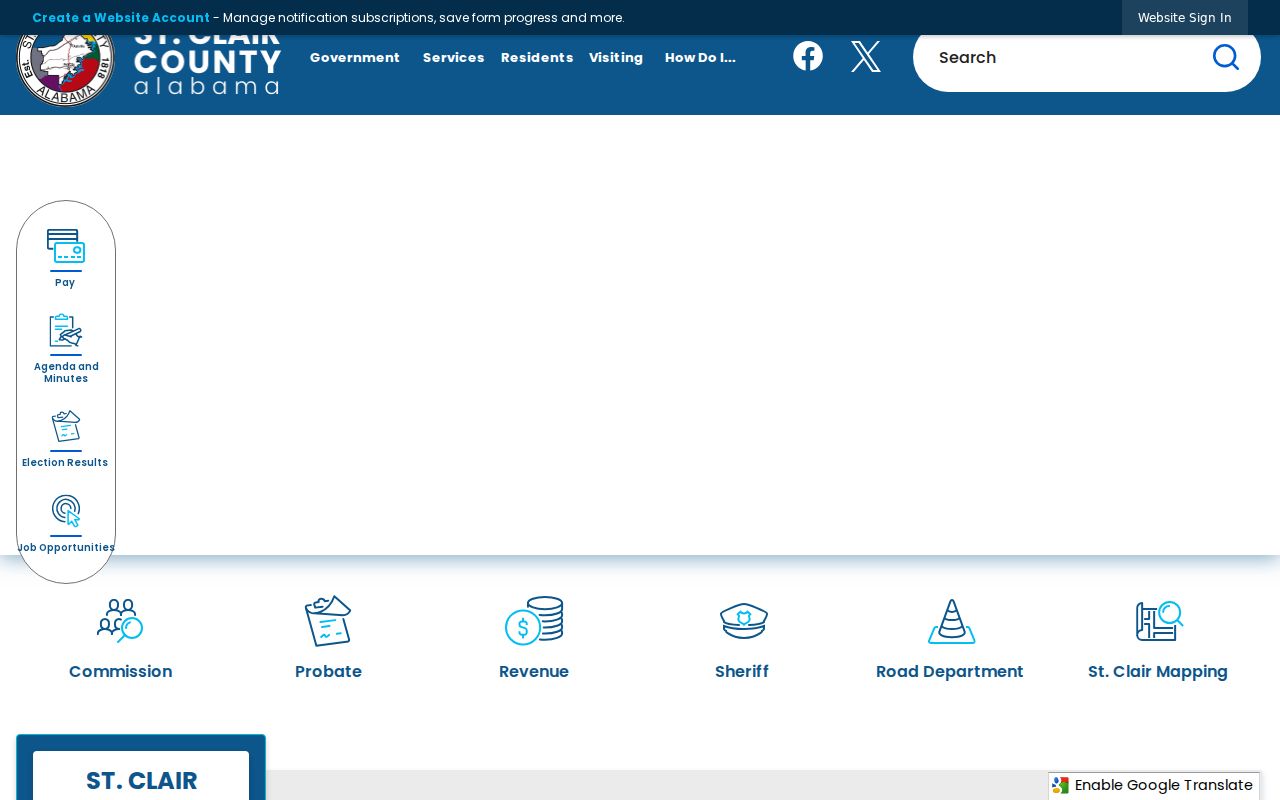
The county directory is a starting point, not a merged criminal-history database.
Two St. Clair Court Record Counters
St. Clair County has two county seats and two working Circuit Clerk counters. The Ashville office is in the St. Clair County Courthouse at 100 6th Avenue North, Suite 400, Ashville, AL 35953, and can be reached at 205-594-2184. The Pell City counter is at 1815 Cogswell Avenue, Suite 217, Pell City, AL 35125, with phone 205-338-2511. Both publish weekday hours from 8:00 a.m. to 5:00 p.m.
These are not rival criminal-record systems. One Circuit Clerk keeps the District and Circuit Court records for Alabama's 30th Judicial Circuit. The two counters make access easier across a county divided between Ashville and Pell City. A case number and court level matter more than the city printed on the courthouse address. Court-issued warrants, certified dispositions, older files, and missing electronic records belong with the clerk, not the sheriff's records desk.
Two Circuit Clerk Counters
Ashville: 100 6th Avenue North, Suite 400, Ashville, AL 35953, 205-594-2184
Pell City: 1815 Cogswell Avenue, Suite 217, Pell City, AL 35125, 205-338-2511
Both counters: Monday-Friday, 8:00 a.m.-5:00 p.m.
Alabama Official Background Checks
Alabama does not provide an unrestricted public ALEA rap-sheet name search. The Alabama Background Check System is a restricted subscription product for organizations that qualify under state law. A member of the public who wants to inspect his or her own official Alabama criminal history uses ALEA's fingerprint-supported Application to Review Alabama Criminal History Record Information instead.
The personal packet requires a classifiable fingerprint set from an authorized law-enforcement agency with an FBI-issued ORI, a qualifying unexpired photo ID, the signed application, and a $25 cashier's check or money order. Additional certified copies cost $5 each. ALEA accepts mail at Records & Identification Division, P.O. Box 1511, Montgomery, AL 36102-1511, and identifies a public-facing location at 301 S. Ripley Street in Montgomery. ALEA states at least five to ten business days after receipt. No official St. Clair County page located in the research publishes a local fingerprint schedule or fee, so call before visiting.
The ALEA criminal-history page separates the restricted subscriber system from personal record review.
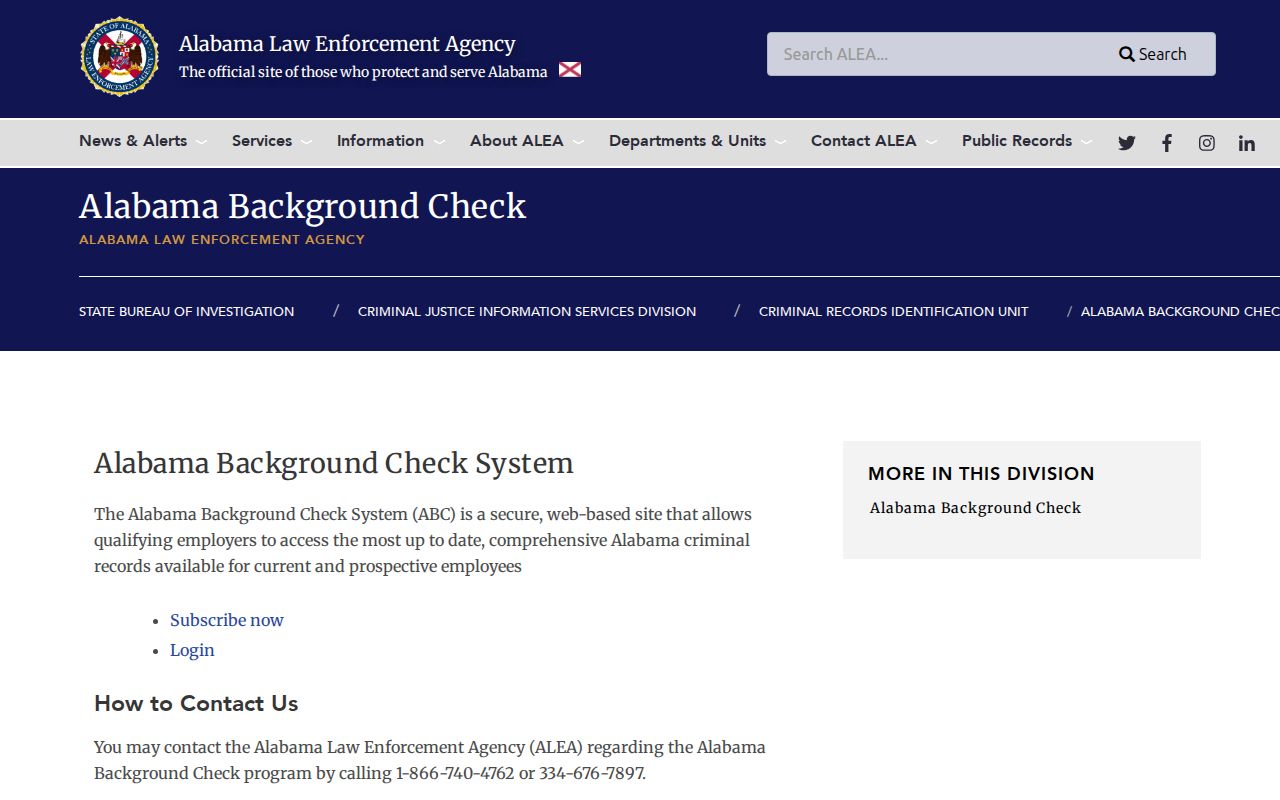
That distinction prevents a restricted account portal from being mistaken for a public people search.
No Public Alabama Rap-Sheet Search
A common St. Clair County criminal history mistake is treating Just One Look, the sheriff roster, or the Alabama Background Check System as the same product. They are not. Just One Look is a paid trial-court service. The roster is a free local custody record. ABC is limited to qualifying subscribers. ALEA personal review is fingerprint based and returns the applicant's own Alabama CHRI, which may contain arrest cycles from outside St. Clair County.
ALEA's Criminal Records Identification Unit maintains fingerprint files for arrested offenders and receives reports from agencies and courts. Yet ALEA warns that older matters were not always reported, some local files remain nonautomated, and some information has not reached the repository. A blank state result cannot erase an existing clerk or police file. When a disposition is missing or wrong, obtain certified proof from the reporting court and use ALEA's formal challenge process within the time stated in the response.
The ALEA Criminal Justice Services overview identifies the units that maintain Alabama criminal-history and fingerprint records.
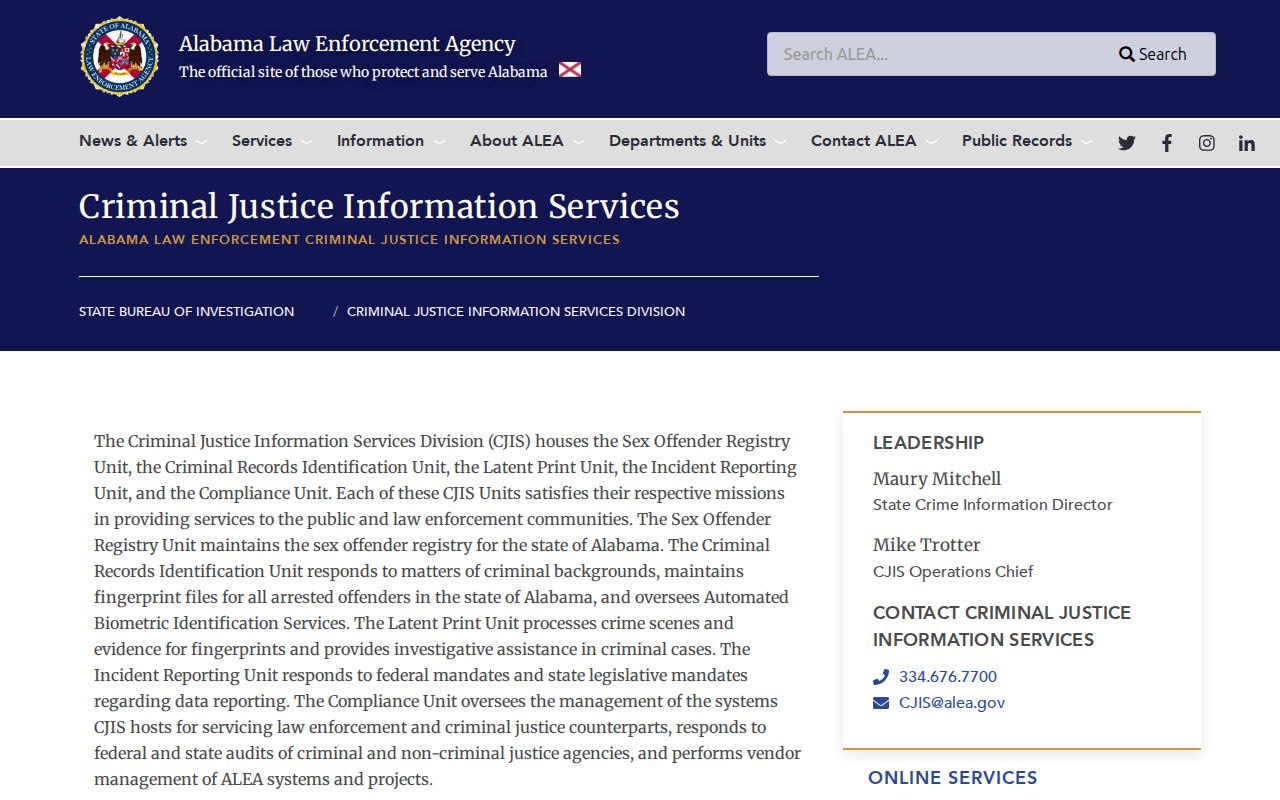
The state repository is one layer of the record flow, not a copy of the complete local case file.
Criminal Record Types
St. Clair County criminal records are best sorted by who created them and when. A reported event may produce a police narrative, an arrest entry, a county booking, a prosecutor's charge, a court docket, and a fingerprint-linked ALEA cycle. Those entries overlap, but one cannot stand in for all the others.
The record holder determines the request route:
- Incident and offense reports remain with the sheriff, city police department, or state agency that investigated.
- Arrest records describe the legal basis, time, place, suspected offense, and arresting agency.
- Booking records show county jail intake, charges recorded then, bond, and custody dates.
- Court case files show filed charges, hearings, pleas, rulings, disposition, and sentence.
- ALEA CHRI links identity and fingerprint-supported arrest cycles with dispositions reported to the state.
Warrants also have their own source. A judge or magistrate issues the process, and the court clerk holds the court record. The sheriff's Most Wanted page is only a selected list.
One St. Clair Arrest, Three Records
A St. Clair County arrest commonly produces three records that answer different questions. The jail booking proves an intake and custody event. The court file tracks what prosecutors actually filed and how the judge resolved it. ALEA CHRI is the statewide fingerprint-indexed history assembled from agency and court reports. The initial charge can change before filing, and a filed charge can later be dismissed, no-billed, amended, resolved by plea, or tried.
The cleanest review follows a straight line: Arresting agency → St. Clair County Jail booking → District or Circuit Court case → ALEA disposition update. If a city officer made the arrest, the narrative stays with that city even when the jail and later court records are county-held. This is why the arresting-agency field on a booking profile is so useful.
| Source | Best evidence | Key limit |
|---|---|---|
| County roster | Booking and custody | Not proof of guilt |
| Circuit Clerk | Filed charge and disposition | Not the police narrative |
| ALEA CHRI | Fingerprint-linked state history | Reporting gaps can occur |
Note: A court disposition is the strongest source for the outcome of a St. Clair County criminal charge.
Inside a St. Clair County Criminal Record
What appears depends on the product. The sheriff's public inmate profile shows a booking photo, name, booking number, age, gender, race, city and state level address, arresting agency, booking and release times, charges, and aggregate bond. It does not publish many fields people may expect, such as a court date, statute number, housing pod, warrant number, officer name, or per-charge bond breakdown.
A Just One Look case detail instead can contain basic case information, court action, status, settings, parties, financial history, and a detailed case-action summary. ALEA CHRI may associate identifiers and fingerprints with an arresting agency, arrest date, charge, and reported disposition.
| Identity | Name and identifiers used to match the person to the record. |
|---|---|
| Arrest and booking | Agency, intake date, booking number, alleged charges, bond, and custody status. |
| Court action | Filed charge, settings, pleas, motions, rulings, and case-action entries. |
| Disposition | The result for each charge, such as dismissal, no bill, acquittal, or conviction. |
| Sentence | The court-ordered consequence and any financial history shown in the case file. |
| State history | Fingerprint-supported arrest cycles and dispositions reported to ALEA. |
Inside the St. Clair Inmate Roster
The official St. Clair inmate roster is free and needs no account. Its search accepts comma-separated terms across name fields and the arresting-agency field. Readers can switch among current, released, and archived inmates, change between name and date views, and sort from newest to oldest or the reverse. A booking number and date provide a safer match than a name alone.
The roster warns that charges and bail can change after court appearances. Call the jail at 205-814-3525 for current bail, charges, and case numbers when those details affect an immediate decision. The roster is not a daily multi-agency police blotter and does not reveal the final case disposition.
The sheriff's official Most Wanted page is a selected public list, not a full custody or warrant index.
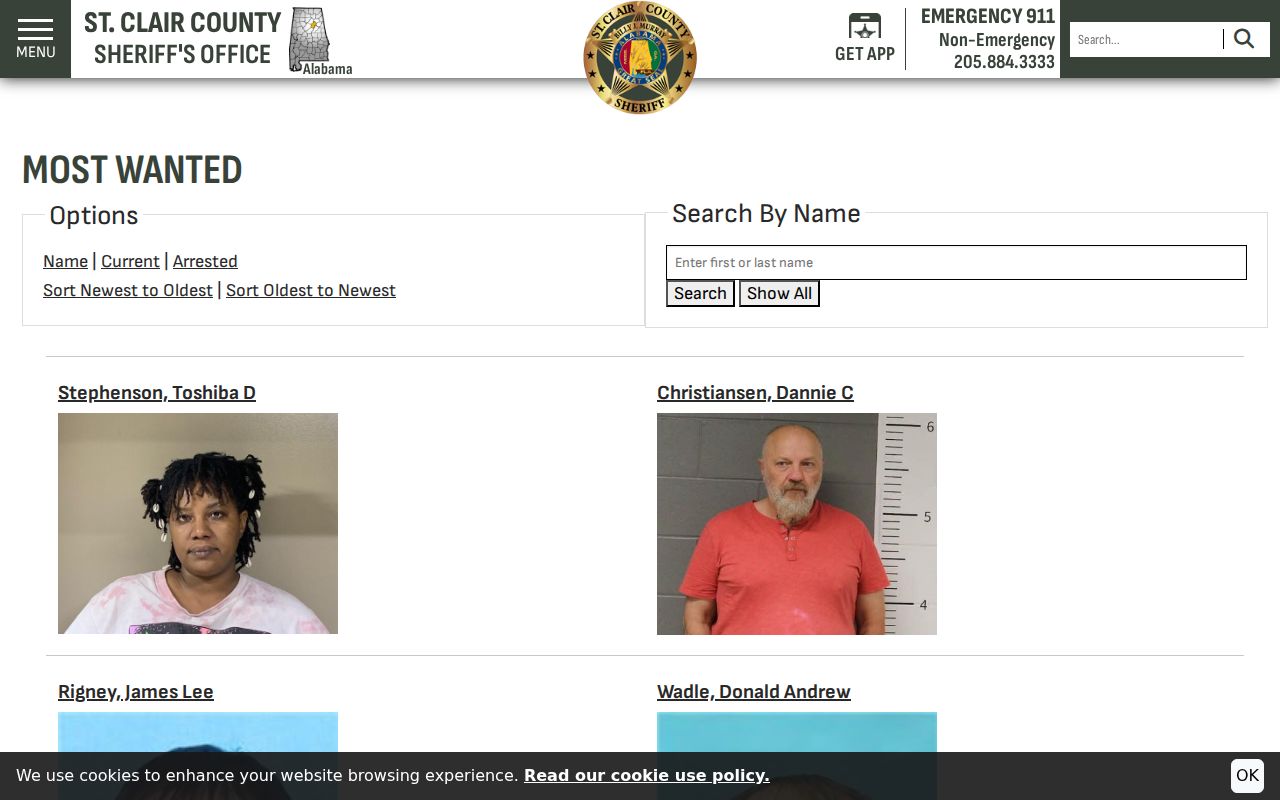
A selected Most Wanted listing cannot serve as proof that no active warrant exists.
Public Access Laws in Alabama
Public access does not mean that every St. Clair County criminal record is open in full. Alabama law supports inspection and copying of public writings, while separate rules govern criminal-history dissemination and court jurisdiction. Juvenile files, expunged matters, protected victim or minor information, confidential identifiers, and material protected by another law can remain restricted. Pending-investigation material may also be withheld. A focused request for an existing record gives the custodian a better chance to identify releasable material and redact only what must remain private.
When a St. Clair County criminal record is partly exempt, ask whether a redacted copy is available. Include the agency, date range, case or report number, and exact document sought.
Key Alabama laws:
Ala. Code §36-12-40 establishes the baseline citizen right to inspect and copy public writings, subject to exceptions.
Ala. Code §41-9-621 governs criminal-justice information access and dissemination.
Ala. Code §12-11-30 assigns felony jurisdiction to Circuit Court.
Title 15, Chapter 27 sets Alabama expungement eligibility and procedure.
St. Clair Sheriff Records Requests
The Sheriff's public-records request process applies to records in sheriff custody. Under the current Act 2024-278 procedure, the requester must certify Alabama residence and provide reasonable proof, such as an Alabama driver license or voter registration. The request must identify an existing record with reasonable specificity. The office need not create a new report or fulfill a vague, overly broad, or unreasonable demand.
Send the standard form to SORecordsRequest@stclairco.com, mail it to St. Clair County Sheriff's Office, Attn: Tawney Roberts, 1610 Cogswell Avenue, Suite 206, Pell City, AL 35125, or deliver it there. The office has up to ten days to acknowledge a proper request and, after acknowledgment, fifteen business days to fulfill or deny it. Wait for a cost quote before paying. A victim seeking the incident or offense report he or she made has a narrower counter route: present identification during weekday office hours and pay $3 cash per report.
| Request route | Cost | Use |
|---|---|---|
| Victim incident report | $3 cash | Report made by that victim |
| Standard public-records form | Quote required | Specific existing sheriff record |
| ALEA personal review | $25; $5 extra copy | Own fingerprint-linked Alabama CHRI |
The sheriff's official app announcement documents its public information features.
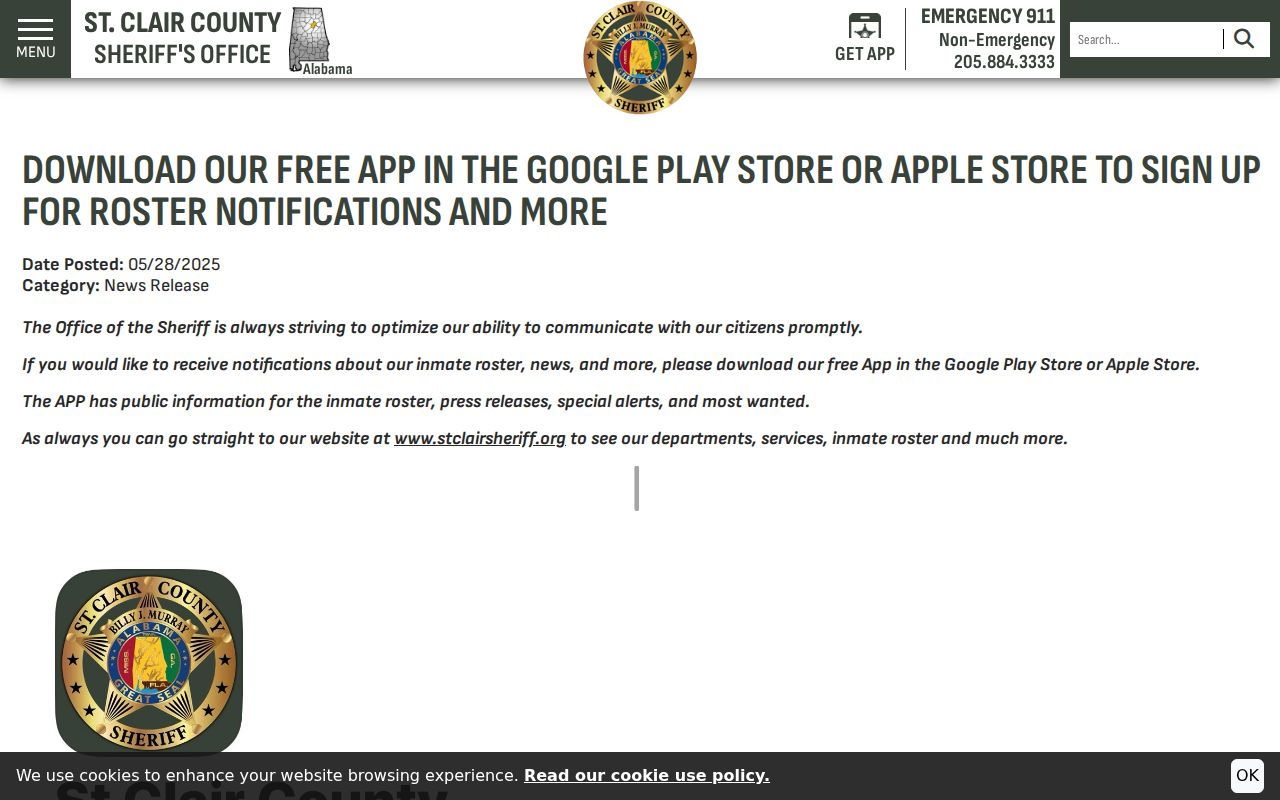
The St. Clair County Alabama Sheriff App adds roster information, notifications, press releases, alerts, and Most Wanted, but no broader warrant database was verified.
Sealed, Expunged, and Restricted Records
Alabama uses the term expungement. A qualifying charge removed through Title 15, Chapter 27 should leave public criminal-history access, while courts and law enforcement retain limited official access. Expungement does not itself restore firearm rights. Juvenile records, protected victim or minor details, Social Security numbers, and other confidential identifiers also fall outside normal public access.
A St. Clair County expungement petition is filed in the criminal division of Circuit Court for the county where the charge was filed, even if the original matter began in municipal or district court. Obtain a certified ALEA CHRI plus a certified arrest record, disposition, or case-action summary. The current CR-65 form calls for one offense per petition, so a case with several counts may require several petitions. The prosecutor or victim may object, and the court may seek more information or hold a hearing. The official local filing fee was not found in the research, so confirm it with the clerk rather than relying on an old figure.
After an order, check both the public court search and a new ALEA self-review. If the official state entry remains wrong, submit the certified court proof through ALEA's challenge process.
St. Clair County Custody Layers
The county jail, Alabama Department of Corrections, and Federal Bureau of Prisons cover different custody levels. The St. Clair County Jail at 100 18th Street North in Pell City holds pre-sentenced and sentenced people in local custody. ADOC Inmate Search covers people in Alabama state-prison custody. BOP Inmate Locator covers federal custody. A person may disappear from the current county roster after release or transfer without the underlying court case disappearing.
Probation and parole add a separate layer. The Alabama Bureau of Pardons and Paroles runs local field offices at 111 20th Street North in Pell City and 35755 U.S. Highway 231 in Ashville. A court docket may show the sentence, ABPP holds supervision information, and ADOC shows prison custody. None is a substitute for the others.
The ABPP county directory identifies the state-run supervision structure.
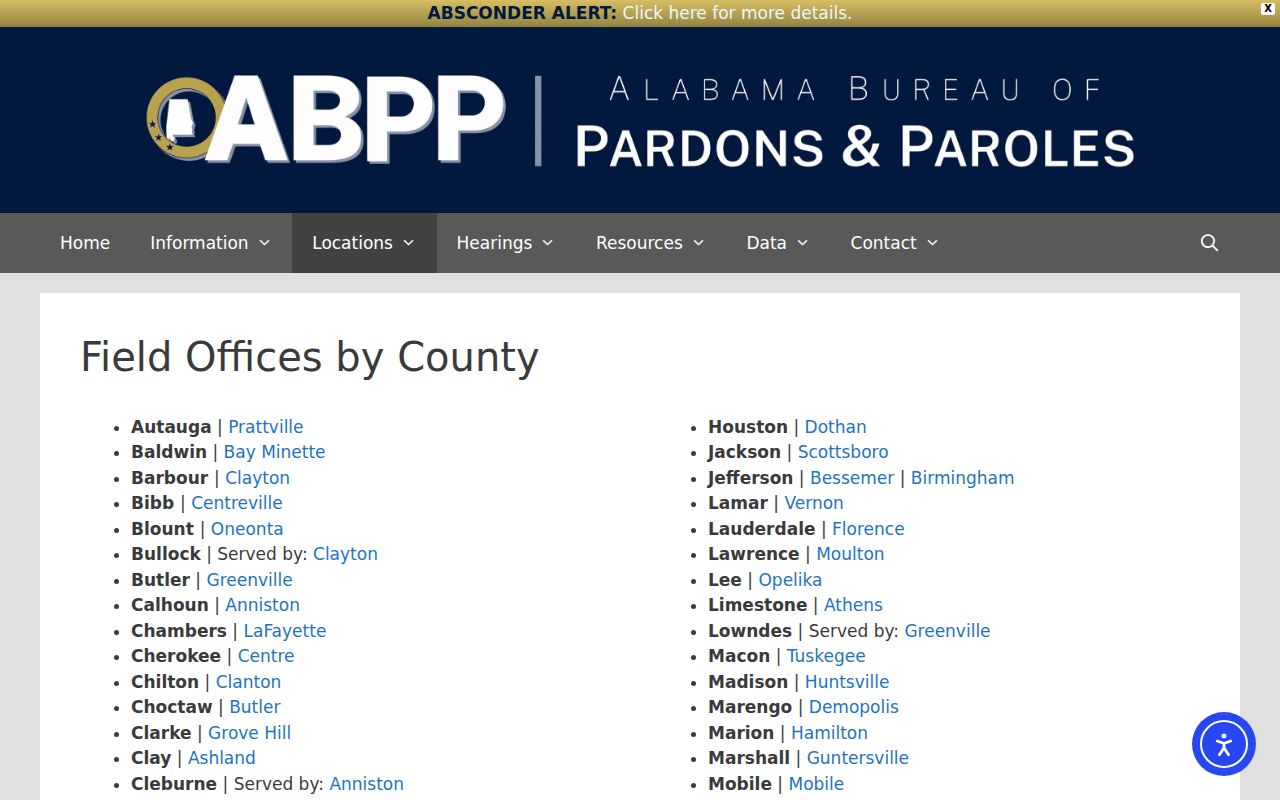
St. Clair County does not operate a separate county adult probation department.
The federal BOP locator supplies the last custody layer for this comparison.
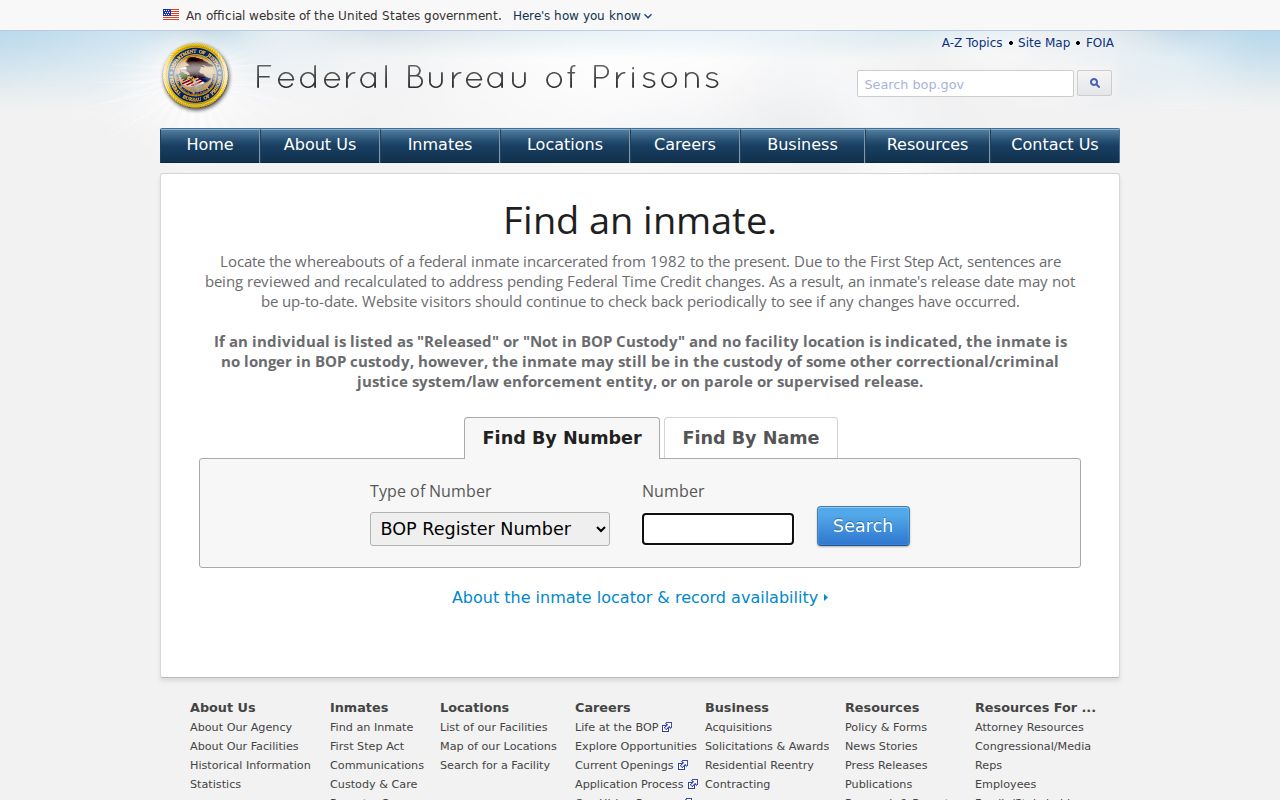
Federal dockets remain in PACER rather than Alabama Just One Look.
St. Clair County Criminal Records by City
City police reports remain with the department that created them, even when the person is booked into the St. Clair County Jail. Municipal courts keep their own traffic, ordinance, and lower-level case records. Pell City, Moody, and Odenville are the county's three largest incorporated cities by the Census Bureau's 2025 estimates, and each has a distinct record counter or request channel.
Use the city guide for the local police and municipal court step, then move to the county clerk for District or Circuit prosecution.
Pell City Criminal Records
14,320 residents · Police crash retrieval, city request form, and Tuesday municipal court.
Moody Criminal Records
13,559 residents · Daniel Drive police reports and two monthly court dockets.
Odenville Criminal Records
6,023 residents · Police report counter and first-Thursday municipal court.
St. Clair Most Wanted Is Limited
The sheriff's Most Wanted page allows a first- or last-name search and separates current from arrested listings. It is intentionally selective. Absence from that page is not warrant clearance, and the sheriff app's Most Wanted feature was not shown to contain a broader database. County-court warrant questions go to the Circuit Clerk. Municipal and bench warrants stay with the issuing court.
A safe fallback chain starts with the issuing court, checks the jail roster if an arrest may have occurred, and uses a specific sheriff records request only for responsive records held by that office. Counsel can advise on surrender or bond. Pell City Police also warns that it does not demand money through a warrant-notice phone call and does not take Venmo for bail or fines.
The official Most Wanted source shows the selected-list interface. The separate Alabama Background Check System is also an official source, but it is restricted and cannot clear a warrant.
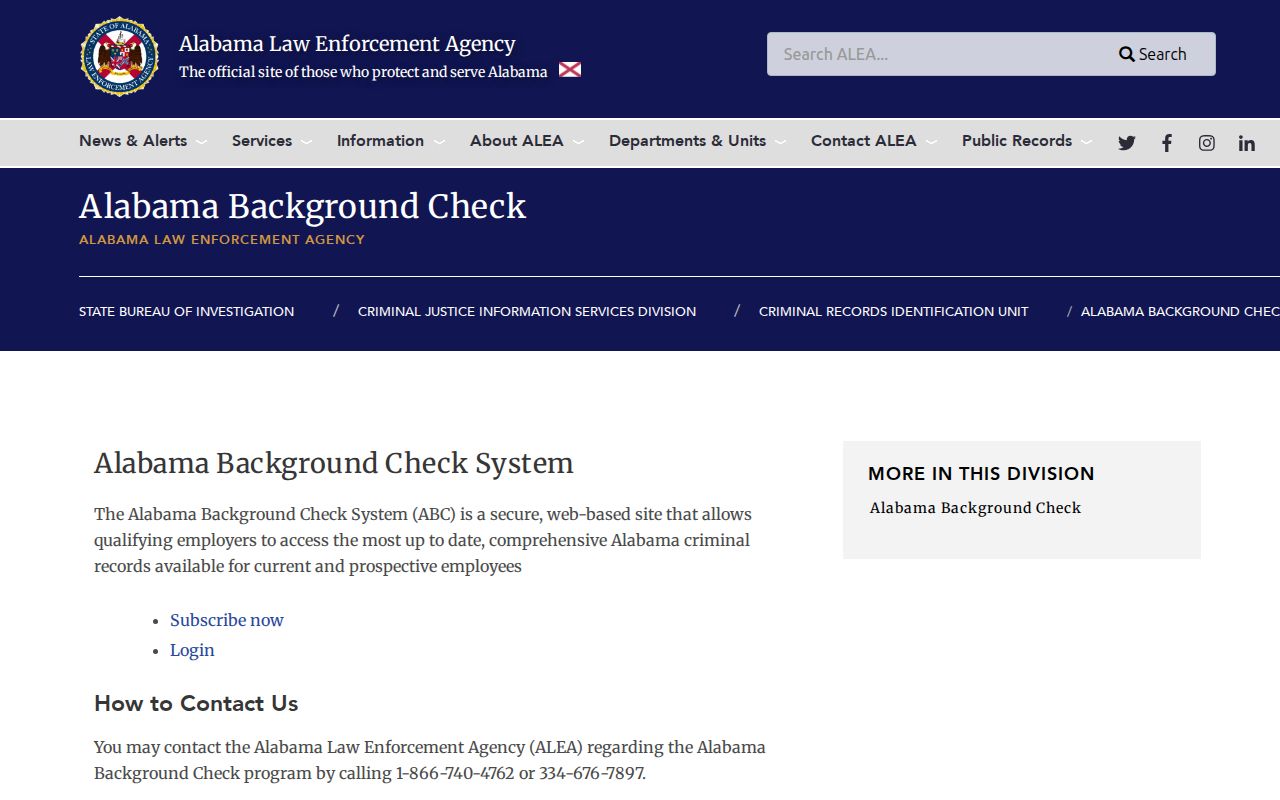
Neither a restricted background-check portal nor an unexpected payment demand replaces direct contact with the issuing court.