
St. Clair County Criminal Court Cases
St. Clair County is Alabama's 30th Judicial Circuit. Circuit Court has exclusive original jurisdiction over felony prosecutions and related lesser offenses under Ala. Code §12-11-30. District Court handles misdemeanor criminal and traffic matters as well as preliminary functions in felony cases. A municipal charge may start in a city court, but a state felony file belongs in the Circuit Court system.
The Circuit Clerk is the official keeper for both District and Circuit Court records. The office manages pleadings, subpoenas, notices, fines, fees, electronically imaged files, and the Criminal, Traffic, Juvenile, and Warrants divisions. That role makes the clerk, not the sheriff or prosecutor, the right source for a certified disposition or court case-action summary. An arrest entry can point toward a case, but it cannot establish the filed charge or final result.
Two St. Clair Court Counters
St. Clair County has one circuit and one clerk, yet residents can use counters in Ashville or Pell City. The county's official court-office map shows both locations. This arrangement is useful, but it can cause a false split in how people think about the records. The case number and court level matter more than the city on the courthouse door.
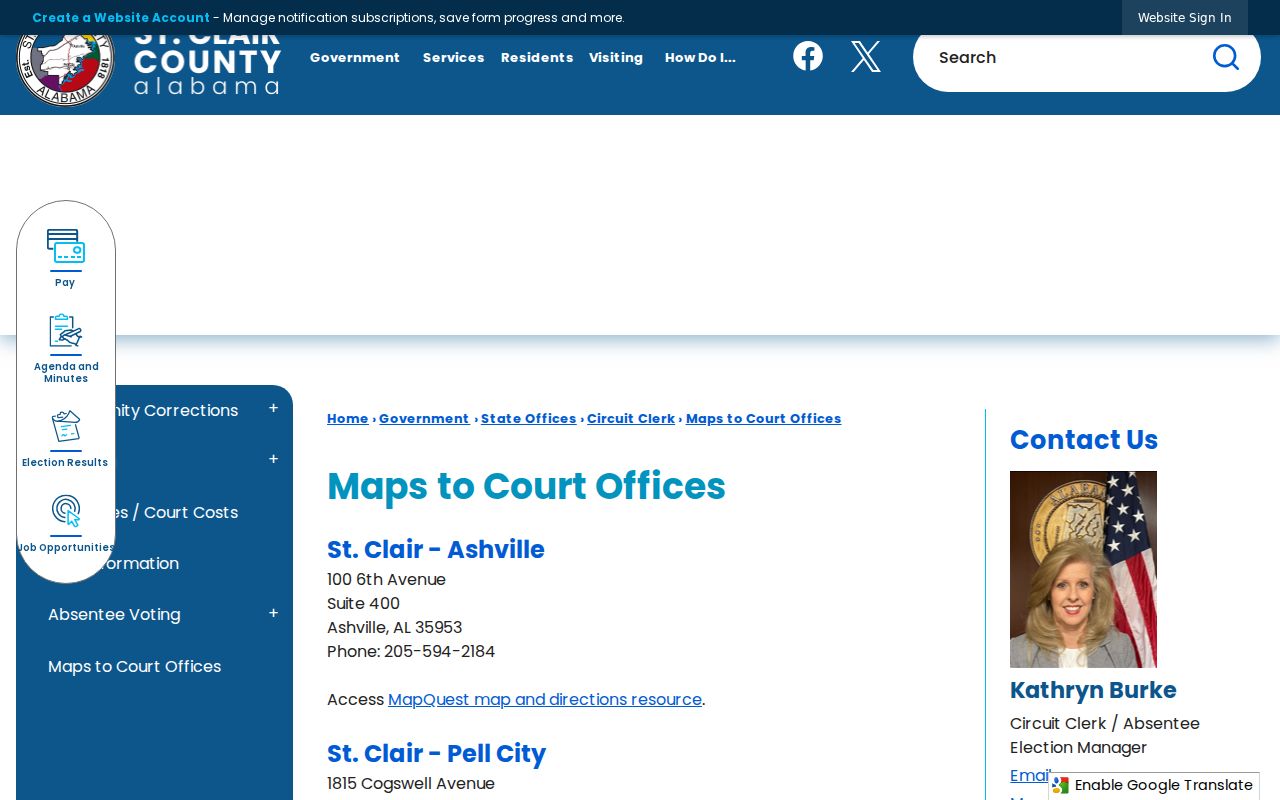
The image places the two St. Clair County criminal court counters in the same county system rather than presenting them as separate repositories.
Ashville Circuit Clerk
100 6th Avenue North, Suite 400
Ashville, AL 35953
205-594-2184
Monday-Friday, 8:00 a.m.-5:00 p.m.
Pell City Circuit Clerk
1815 Cogswell Avenue, Suite 217
Pell City, AL 35125
205-338-2511
Monday-Friday, 8:00 a.m.-5:00 p.m.
Searching St. Clair County Case Records
Just One Look / AlacourtACCESS provides paid, statewide access to Alabama trial-court case details. Search by case number when it is known. A name search can work, but each result must be checked against St. Clair County, the court, charge, and disposition. The public landing page does not reveal date-of-birth, county, or case-type controls before login, so those fields should not be assumed.
- Open Just One Look and register or sign in to the paid service.
- Choose the name-search or case-number mode. Use the exact case number when available.
- Confirm that the result belongs to the right St. Clair County court and person.
- Read the status and case-action summary through the final disposition and sentence.
- Ask the Circuit Clerk for older files, certified copies, or records that do not appear online.
| Search or control | Type | Required | Published notes |
|---|---|---|---|
| Name Search | Paid mode | Not shown before login | $9.99; one case detail included |
| Case Number Search | Paid mode | Not shown before login | $9.99; one case detail included |
| Login or Sign Up | Account control | Yes to transact | Gates field entry and results |
| Document Images | Paid add-on | No | $5 for 20 pages, then $0.50 per page |
| Case Monitoring | Subscriber feature | Account | Sends notices when a future change is entered |
The Alabama Judicial System help desk assists with portal issues at 1-866-954-9411, option 1 then option 4, or AOCHelpdesk@alacourt.gov. It does not replace the St. Clair County clerk for copies.
St. Clair Case Search Costs
Just One Look charges for the search, not for a guaranteed match. A name search costs $9.99 and includes one case detail, with another $9.99 charged for each added case detail. A case-number search also costs $9.99 and includes one case detail. The portal states that a “No Matching Records on File” response still counts as a search. This matters when a name is common or may be spelled in more than one way.
The official Just One Look entry screen shows the access point used for St. Clair County criminal court cases.
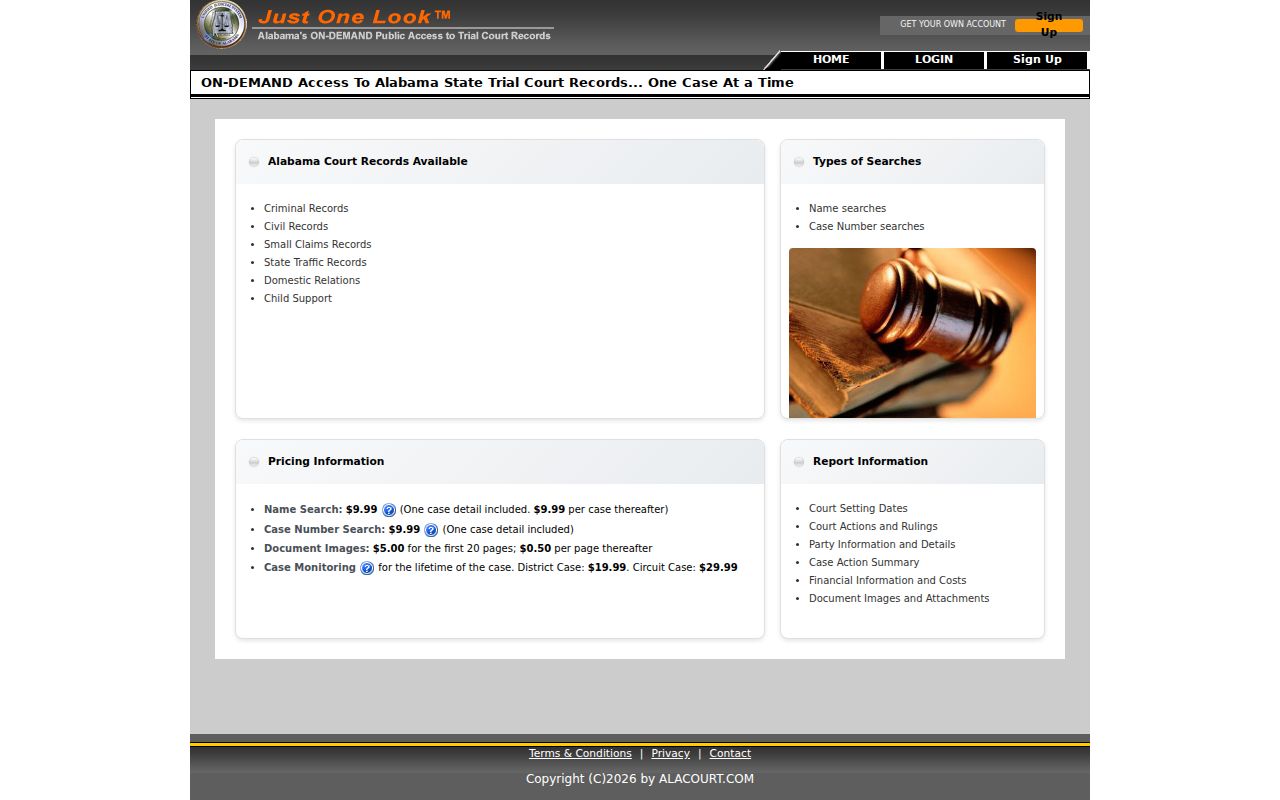
The portal view reinforces why an exact case number can save paid searches and reduce the risk of opening the wrong same-name record.
Purchased images are not the same as a certified clerk copy. Use an image when the docket line lacks enough context. Use the St. Clair County clerk when the record must show an official disposition or certification. AlaFile is the filing channel, including for registered self-represented filers, rather than a public case-search substitute.
Inside a St. Clair County Case File
A St. Clair County court file records the prosecution, not merely the custody event. Just One Look describes its report as basic case information, court action, case status, setting dates, parties, financial history, and a detailed case-action summary. Filed documents can add the complaint or indictment, motions, orders, plea papers, and judgment. Exact judge, lawyer, bond, sentence, and charge-code fields were not confirmed without a paid sample.
| Case Number and Court | Identifies the specific District or Circuit Court matter and keeps same-name results apart. |
|---|---|
| Charging Document | Shows the complaint, indictment, or other filed accusation rather than the booking wording. |
| Case-Action Summary | Lists court events in time order, including filings, settings, pleas, and rulings. |
| Status and Settings | Shows whether the matter is pending and lists scheduled court dates in the portal report. |
| Disposition and Judgment | Records dismissal, acquittal, conviction, or another outcome for each filed charge. |
| Sentence and Financial History | May show the court's consequence and case-linked fines, fees, or payment entries. |
When one field seems unclear, read it beside the dated case-action entries. A status label may describe the whole case while each St. Clair County charge has its own outcome.
Reading St. Clair Case Outcomes
The final disposition carries more weight than an arrest hit. “Pending” means the court has not reached a final outcome. “Nolle prossed” means the prosecution was discontinued. “No bill” means the grand jury did not indict, while an indictment or true bill means it did. A dismissal, acquittal, and conviction are distinct results and should never be grouped as one kind of case history.
- Case-action summary
- The time-ordered list of filings, hearings, rulings, and other court events.
- Arraignment
- The hearing at which the charge is addressed and a plea is entered.
- Disposition
- The outcome of a charge, such as dismissal, acquittal, or conviction.
- Nolle prossed
- A notation that the prosecution chose not to continue that charge.
- Capias
- Court process directing that a person be arrested.
Note: Read each charge through its own disposition because one St. Clair County case may end with several different outcomes.
How a Criminal Case Moves
After law enforcement makes an arrest, prosecutors decide what to file. Intake wording can change before or after arraignment. Motions, evidence rulings, plea talks, or trial then shape the file, and the court enters the disposition and any sentence. A county booking page may remain useful for the custody date, yet the later court record answers whether the allegation became a filed charge and how it ended.
St. Clair County case flow: Charges Filed › Arraignment › Pretrial › Plea or Trial › Disposition › Sentencing
A St. Clair County criminal court case should therefore be traced from the first filed charge through the last docket action. For the custody event that came before filing, compare the official St. Clair County arrest lookup. A sentence entry can point to probation, jail, or prison custody, but the sentencing order remains the court source.
St. Clair Specialty Court Records
Official judicial biographies identify adult drug court and veterans court in the 30th Judicial Circuit, plus Juvenile Drug Court at the District Court level. A specialty program may add screening, review hearings, treatment conditions, compliance entries, or a later outcome to the case trail. Program completion can also affect disposition and the timing of possible expungement relief.
These programs do not create a public case-search system separate from the clerk. Look for filed court events in the same St. Clair County matter, while expecting juvenile information to face stricter access limits. The underlying docket and order, not the program label alone, show what happened. When a program record is unclear, ask the clerk which public order or case-action summary can be provided.
Older St. Clair Criminal Cases
St. Clair County says its court records are electronically imaged, but it does not promise that all years or documents appear online. A no-match result may reflect spelling, an old file, incomplete indexing, or a record that must be handled at the counter. Ask the clerk about archived material and provide the name, approximate filing year, court level, and case number if known.
The Circuit Clerk remains the source for a certified disposition that can help correct an incomplete state criminal-history cycle. If ALEA lacks an outcome, obtain official court proof for the specific arrest or charge, then follow ALEA's challenge process. This is more reliable than assuming the online absence erased the local record.
Case Record Access & Restrictions
Alabama's public-writings law supports inspection and copying, while the custodian may apply lawful access rules. Public status does not expose every data point. Juvenile files, expunged matters, protected victim or minor information, confidential identifiers, and material protected by another law can remain closed or redacted. Pending investigative material can also be withheld under Alabama public-records doctrine.
The St. Clair County District Attorney prosecutes state cases but does not keep the official public court file. The county prosecutor page helps distinguish that role.
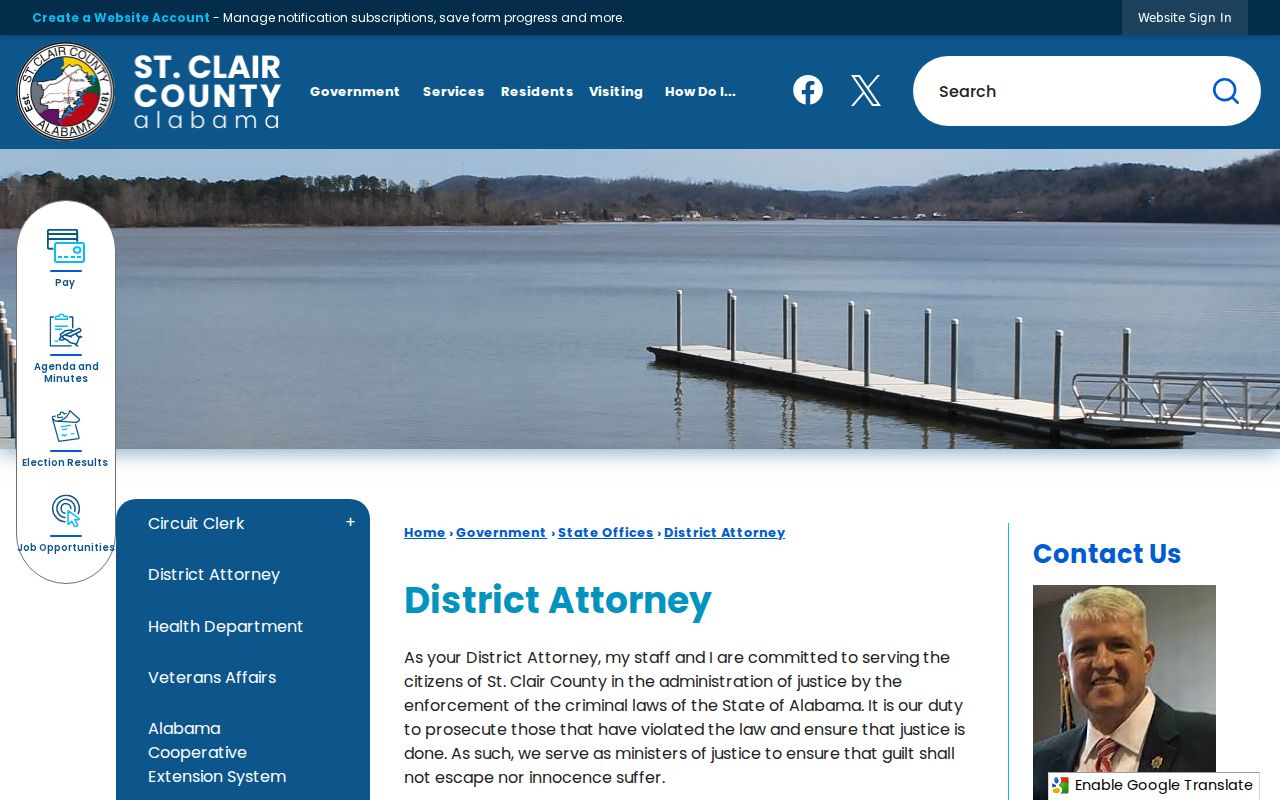
The office view marks the difference between prosecution work and the filed court record held by the Circuit Clerk.