
Sex Offender Checks in St. Clair County
The Alabama Law Enforcement Agency maintains the Alabama Sex Offender Registry through its Criminal Justice Information Services Sex Offender Registry Unit. St. Clair County police and sheriff personnel register people locally, take updated photographs and fingerprints, verify reported information, and send those facts to ALEA. The state agency then publishes the information that Alabama law makes public. This split matters. ALEA is the best first stop for a broad St. Clair County sex offender check, but the local agency is the right channel for a suspected violation, an address correction, or questions about an in-person registration duty.
The registry is a community-notification record. ALEA states that a listing begins after conviction and release to probation or after the custodial sentence ends. It is not a list of mere arrests. It is also not a complete criminal-history search because Alabama publishes only offenses covered by its registry law. For the charge history, filings, outcome, and sentence behind a case, use the St. Clair County criminal court case route. Match more than a name before drawing a conclusion, especially when names are common.
St. Clair Registry Update Chain
St. Clair County registry information moves from a local counter to ALEA. A registrant reports to law enforcement in each county tied to a residence, workplace, or school. City residents begin with their city police department. The St. Clair County Sheriff's Office handles county registration at its Ashville office, 48 6th Street, Suite 300, Ashville, AL 35953, phone 205-594-2140. The local office gathers changes and verification material, then ALEA uses those submissions to maintain the public state record.
ALEA says the public system updates daily in real time from local submissions. That does not mean an old address should be ignored. It may signal that the registrant failed to report a move. Contact the police department responsible for that address or the sheriff rather than approaching anyone at the location. ALEA's Registry Unit also handles corrections at 334-676-7898 or sexoffenderunit@alea.gov.
The ALEA registry explanation and frequently used rules show how state publication depends on local reporting.
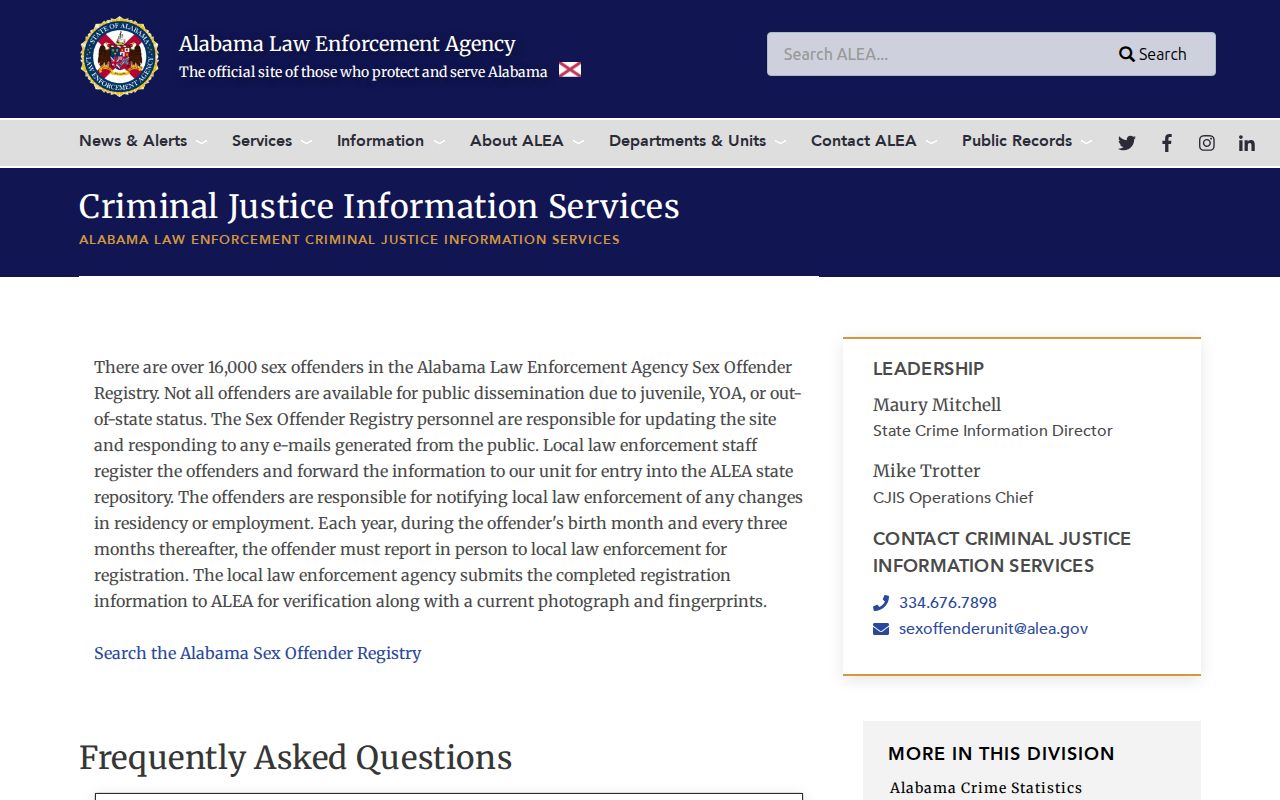
The official explanation is useful when a St. Clair County registry result seems incomplete or needs correction through the proper agency.
How to Search the Alabama Sex Offender Registry
The authorized Alabama registry supports both identity and place-based searches. The vendor interface restricted automated inspection, so its exact current button labels and radius choices were not confirmed. The search capabilities below come from Ala. Code §15-20A-8(e) and official state material. No account or fee is indicated. Avoid guessing at controls the live page does not show, and use the fields that are available when the search opens.
- Open the Alabama Sex Offender Registry search from ALEA's authorized link and read its conditions.
- Use a name for a known person, or choose St. Clair County, a city, ZIP code, or an address-radius mode for a place search.
- Review the result list carefully. Compare the photograph, aliases, physical description, offense, and address rather than relying on one shared name.
- Open the public profile, note its status, and report a suspected bad address or violation to the responsible St. Clair County law-enforcement agency.
| Field or Mode | Type | Required | Verified Scope |
|---|---|---|---|
| Name | Text fields | Unspecified | Statutory search capability; current first/last split was not re-verified |
| City or town | Text or selection | Optional | Searches a named Alabama place |
| County | Selection | Optional | Select St. Clair for a county-wide result set |
| ZIP code | Text | Optional | Geographic input; no portal format notice was visible |
| Address radius | Mapped place search | Optional | Official material confirms radius searching, but current distances were blocked |
Note: An empty place search is not a guarantee that no registrant or nonpublic qualifying history exists in that area.
St. Clair Registry Publication Limits
A no-match result has several possible meanings. ALEA publishes offenses listed in Ala. Code §15-20A-5, not every offense with sexual conduct in its facts. ALEA says a first indecent-exposure or sexual-misconduct conviction is registered and verified but is not placed on the public website. Juvenile matters are generally withheld unless a risk assessment leads to high-risk publication. Youthful-offender cases are generally not posted unless the person was older than 18 when the offense occurred.
Some convictions from another state, federal court, military court, or Indian country may wait for Alabama's due-process determination. A St. Clair County resident can therefore have a matter that does not appear in a public registry search. The system also excludes arrests that did not lead to a registry conviction. These limits are why a registry search should answer a focused safety question, not stand in for a complete case or fingerprint history.
ALEA's public materials also explain that Social Security numbers, victim identities, travel and immigration document numbers, email and online identifiers, internet providers, and non-conviction arrests are withheld. Privacy limits do not make a public profile unreliable. They define the record's lawful scope.
Inside a Registry Profile
A St. Clair County registry profile combines identity, place, offense, and compliance facts supplied through local law enforcement. Read the fields together. A photograph and physical description help distinguish people with similar names, while aliases can explain a different spelling in a court record. Residence, school, work, and vehicle details help with place-based safety planning. Status can show whether the person is reported as compliant, absconded, or otherwise noncompliant.
| Name and Aliases | Full registered name, aliases, nicknames, and ethnic or tribal names |
|---|---|
| Photo and Description | Current photograph plus sex, race, age or birth date, height, weight, hair, eyes, scars, marks, and tattoos when displayed |
| Reported Places | Each residence and applicable school or work address, including transient work details when relevant |
| Vehicles | License plate and description for each reported operated vehicle |
| Conviction | Qualifying crime, jurisdiction, and available conviction information, not an arrest without conviction |
| Registry Status | Compliance information, including an absconded or noncompliant marker when reported |
| Withheld Data | Victim identity, SSN, online identifiers, provider details, travel document numbers, and non-conviction arrests |
Each field has a narrow job. A residence line reports what is on file, while the status line may signal a verification problem. Neither line gives permission to visit or contact an address.
St. Clair Local Offender Verification
Adults generally report in person during their birth month and again every three months. Changes normally must be reported at once, which Chapter 20A defines as within three business days. The duty follows each relevant residence, work, and school county. That can require more than one local agency when daily life crosses county lines. City residents start with city police, while the sheriff provides the St. Clair County counter for its jurisdiction.
Verification is more than an online form. Local staff receive the registrant, review changes, and provide the updated photograph and fingerprints that ALEA uses. Alabama also authorizes an annual registration fee, but the current amount charged at the St. Clair County counter was not found in the official county sources. Confirm the amount directly before visiting.
The official Alabama registry publication law sets the public-data and correction framework.
Those statewide rules connect the St. Clair County verification visit with the profile that residents later see online.
Alabama Registration Levels and Requirements
Alabama does not use a simple public Tier I, Tier II, and Tier III chart with standard ten-year or twenty-five-year terms. Adults are generally subject to Chapter 20A for life, though narrow petition-based relief may apply. A sexually violent predator is a separate judicial designation. Juvenile publication depends on risk assessment. Importing another state's tier labels into a St. Clair County registry search would give the wrong picture.
| Alabama Category | Duration or Public Result | Verification or Related Duty |
|---|---|---|
| Adult sex offender | Generally life, subject to narrow statutory relief | Birth month and every three months thereafter |
| First indecent-exposure or sexual-misconduct conviction | Registered but not publicly posted for that first conviction | Registration and verification still apply |
| Juvenile adjudication | Risk assessment controls public notice; lifetime duties may be ordered | Duties depend on the court and risk finding |
| Sexually violent predator | Separate judicial designation | At least ten years of post-release electronic monitoring |
The table describes legal categories, not a prediction of risk. The public profile, court order, and local agency remain the sources for one person's current duties.
St. Clair Sex Offender Location Rules
Alabama's residence and notice distances answer different questions. Ala. Code §15-20A-11 generally bars an adult registrant from establishing or maintaining a residence within 2,000 feet of school or childcare property, with additional restrictions and exceptions. ALEA also states that a person whose victim was younger than 12 may not loiter within 500 feet of a school, childcare facility, playground, park, athletic field, or another child-centered business.
Those legal distances are not the same as a radius selected by a resident on the registry map. A map radius is only a search tool. Community-notice distances govern how notice is delivered. In cities of 5,000 or more, §15-20A-21 uses a 1,500-foot residence notice area. It uses 2,000 feet in smaller cities and unincorporated areas, plus three miles for schools and childcare facilities. Local geography and municipal boundaries can therefore change which notice rule applies.
The official Alabama residence restriction provides the controlling text and its exceptions.
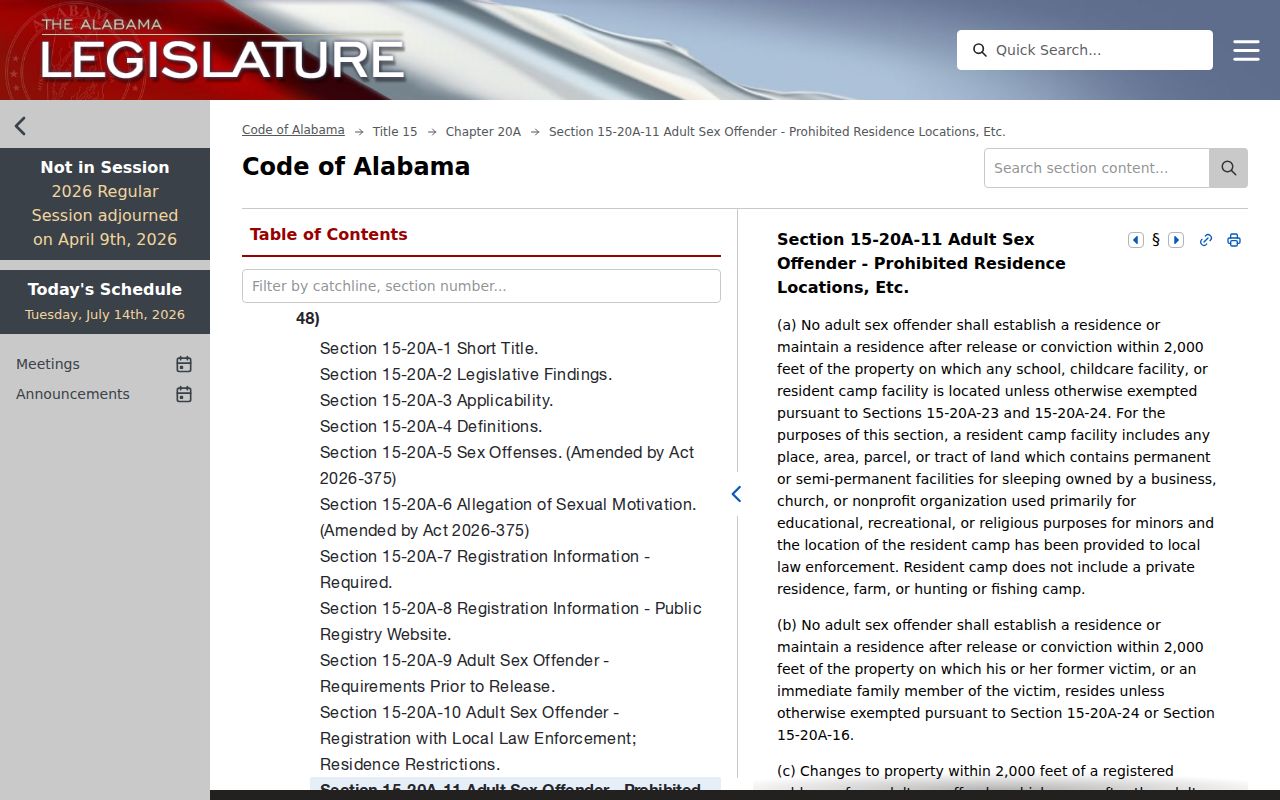
The statute should be read as a legal location rule, not as the list of distance choices on a public registry map.
Community Notification and Lawful Use
Alabama community notification reaches beyond a website. Depending on the setting, notices may be mailed or hand delivered, while electronic, newspaper, or station posting is also allowed. ALEA states that the public portal does not replace those statutory notices. A person who did not see a new web result may still receive a local notice, and a web search is not the only way a St. Clair County neighborhood learns about a registration.
Registry facts support awareness, discussion with family members, and safe choices about public spaces. They should be checked against the profile's date, status, photograph, and reported address. If the address appears wrong, contact local law enforcement. Do not visit the home, workplace, or school and do not try to conduct a private compliance check.
Misuse can be a crime: Ala. Code §15-20A-8(h) bars using registry information to unlawfully injure, harass, or commit a crime against a listed person or anyone at a reported address. Civil or criminal penalties may follow.
St. Clair Registry and NSOPW
The Alabama registry is the direct source for a St. Clair County sex offender search. The National Sex Offender Public Website adds a cross-state layer when a person or address may connect to another jurisdiction. NSOPW draws from participating public registries. It does not erase the publication limits of each state, and it does not turn an empty result into proof that no relevant conviction exists.
Start with St. Clair County fields in the ALEA system when the question is local. Use NSOPW when the search needs to cross Alabama's border or compare more than one state registry. Then return to the listed jurisdiction for its current profile, correction instructions, and local contact. Suspected noncompliance in St. Clair County still belongs with the sheriff or responsible city police department.
The official national registry search provides the broader geographic layer.
Using both official tools can widen a location search while keeping every result tied to the agency that maintains it.